 fred voisin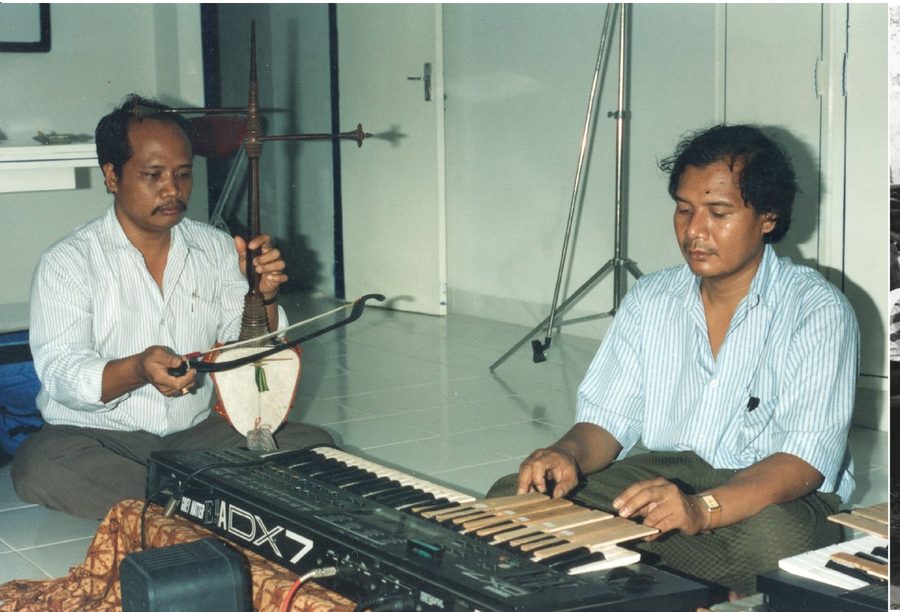
Modelling, simulating, creating: between the arts and the sciences
Fred Voisin has long taken part in various research projects, from ethnography to neuroscience and sound design. An associate researcher at the CNRS from 1989, he joined Simha Arom's team to study the traditional music of Central Africa and Java. This research, partly funded by the Fondation Fyssen, drew the interest of a wide community in the humanities and cognitive science, as well as composers (see About).
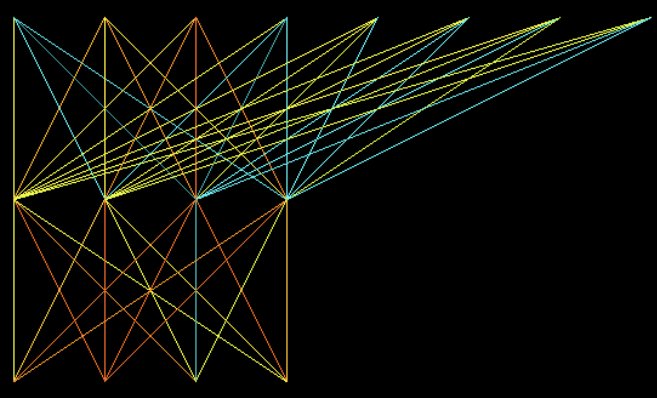
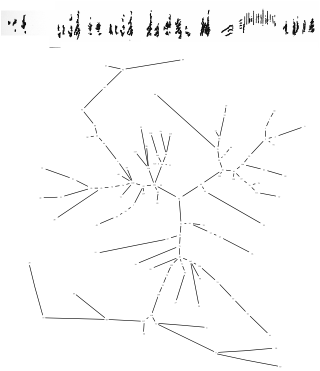
Building on that experience, in 1995 Fred developed, between the CNRS and Ircam, tools for the analysis and generation of forms, in collaboration with composer Jacopo Baboni-Schilingi. Designed for the OpenMusic environment, these tools were praised by a community of young composers.
Having grown familiar with modelling musical cognitive processes, in the context of an experimental ethnomusicology, and simulating them by means of specially dedicated computer systems, Fred started, well before the year 2000 — before generative AI became a mainstream topic —, the Neuromuse project, a "system of neuromimetic networks for musical creation." It was a pioneering project in generative AI that still allows — today — the instantiation of neuromimetic agents able to communicate over MIDI or TCP/IP, in Lisp, in the Max and Puredata multimedia environments, with further adaptations in Python, Java, C++ and ARM... It led to proofs of concept in the form of experimental-music concert-performances, co-produced with various research centres such as Ircam, CIRM, Art Zoyd, but also Telecom Valley, Inria, France Telecom R&D, Eurecom, Infineon, National Taiwan University, and others...
This research today extends into work on sound design (see the SpeaK project), mental health (see Sound, Health & Cognition) and the environment (see Fonocanal).
This research goes hand in hand with a lasting commitment to passing on knowledge, through teaching.
- Development of bespoke generative systems, algorithmic, neuromimetic networks, adaptive audio synthesis engines, embedded, autonomous, bio-inspired systems
- R&D in artificial intelligence applied to sound creation and identity
- Prototyping and advice for experimental or applied-research projects
- Support for laboratories, studios or technical teams wishing to integrate a generative sound component
Productions
Examples of Arts/Sciences applications drawn from musical research or sound design work, in the form of computer tools and artistic productions.
Tools & software
- SpeaK for Max — Max patch for SpeaK, a collaborative platform for sound lexicons, developed with Patrick Susini (graphic design and ergonomics), Ircam - Perception and Sound Design team (2022) — speak.ircam.fr
- Mimer c'est jouer ! — musical exploration prototype based on miming instrument playing, gesture recognition through a neuromimetic network (MoCap, MLP TDNN), with Emmanuel Bigand, LEAD, CNRS - Université de Bourgogne, supported by Cochlear (2017) — PDF
- All Together — musical sonification of movement through wireless sensors, playing together as a group, with Emmanuel Bigand & Philippe Lalitte, LEAD, CNRS - Université de Bourgogne, Fête de la Musique, CNRS Gérard-Mégie campus, Paris (2017) — cnrs.fr
- Neuromuse — neuromimetic network system for musical creation, since 1999 (code repository) — github.com/FredVoisin/neuromuse
- LabanOnLisp (LOL) — experimental environment for choreographic composition in Lisp (1999-2012), developed notably with Myriam Gourfink — documentation
- Morphologie — library for OpenMusic (Ircam), inspired by ethnomusicology and René Thom (1999-2012) — github.com/openmusic-project/Morphologie, project page
Neuromimetic works & installations
- Fonocanal — permanent sound installation on a bank of the Canal de Bourgogne, near lock n°92 (2021), continuously broadcasting sounds generated in situ and in real time from the weather, the seasons and sound archives — visitor data (data.gouv.fr)
- Last Manœuvres in the Dark — with Fabien Giraud, Raphaël Siboni & Robin Meier, Palais de Tokyo, Paris (2008) — robinmeier.net — see also: article, the music (in French)
- Symphonie des machines — installation-concert for neuromimetic agents, Festival de la 4ème Dimension, Sophia Antipolis (2006), supported by the Ville de Paris, SNCF, Sacem, Art Public Contemporain and CIRM — robinmeier.net — see also: article (in French)
Publications
The full bibliography (journal articles, conference proceedings, books & chapters, research reports) is maintained on the About page.